Land Clearing Cost Per Acre (2026)
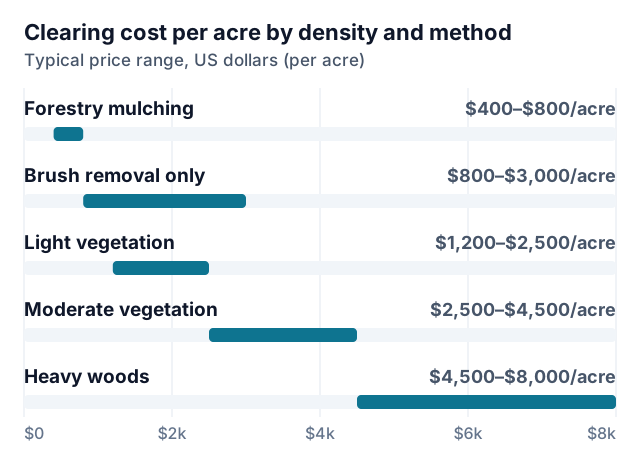
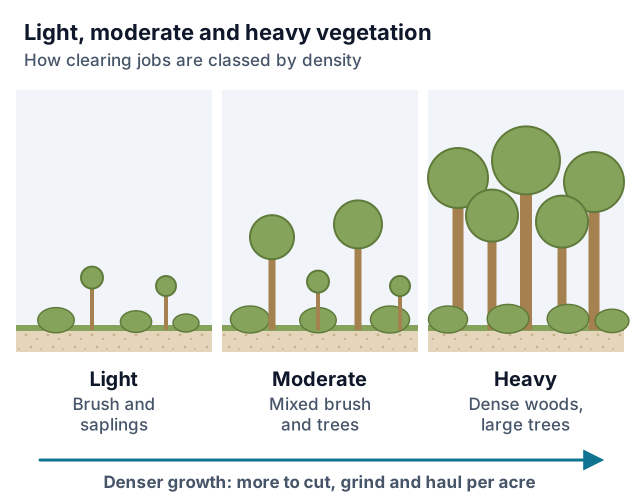
Clearing land costs about $1,200 to $8,000 per acre in 2026, depending mainly on how thick the vegetation is (HomeGuide). Lightly wooded or brushy land runs $1,200–$2,500 an acre. Moderate growth runs $2,500–$4,500. Heavy woods run $4,500–$8,000. Brush-only removal runs $800 to $3,000 per acre (HomeGuide).
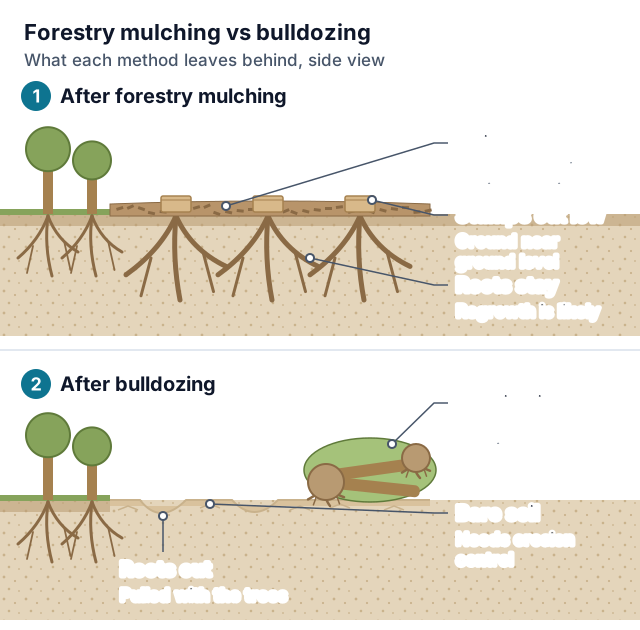
Angi's 2026 data puts the per-acre range lower and wider at $500–$5,600, averaging $3,050 per acre. Its average whole project is $3,780 across 2,416 verified projects. Forestry mulching costs $400–$800 per acre (up to $2,000 when dense; HomeGuide). It's the budget route for land you aren't building on, because stumps are only ground near ground level and the roots stay.
These are national figures published by cost-guide companies, not bids. Local labor rates and your site decide where you land. Ask several contractors for written bids that list clearing, stumps, debris and grading separately, and say who handles permits.
Typical national range
$1,200 – $8,000
HomeGuide; Angi avg $3,050/acre
Cost breakdown
| Item | Typical range | Notes |
|---|---|---|
| Brush removal only | $800 – $3,000 | HomeGuide per acre |
| Light vegetation (brush, saplings) | $1,200 – $2,500 | HomeGuide per acre |
| Moderate vegetation | $2,500 – $4,500 | HomeGuide per acre |
| Heavy woods (dense, large trees) | $4,500 – $8,000 | HomeGuide per acre |
| Lightly forested acre | $500 – $2,000 | Angi per 1-acre project |
| Densely forested acre | $3,600 – $5,600 | Angi per 1-acre project |
| Forestry mulching | $400 – $800 | HomeGuide per acre; up to $2,000 when dense |
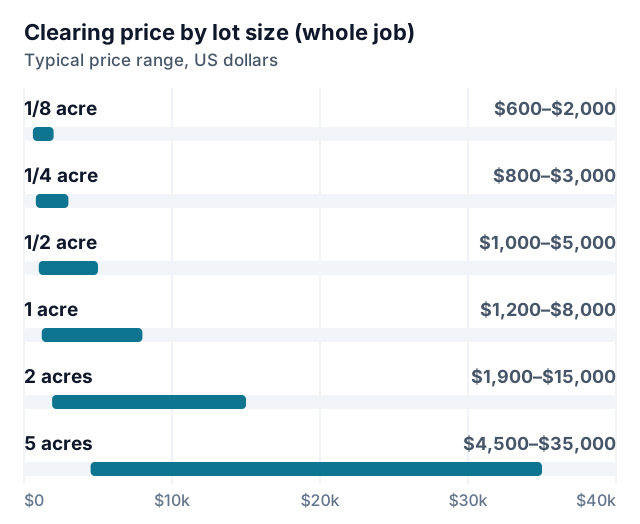
| One-eighth acre lot | $600 – $2,000 | HomeGuide per job |
| Quarter acre lot | $800 – $3,000 | HomeGuide per job |
| Half acre lot | $1,000 – $5,000 | HomeGuide per job |
| 1 acre | $1,200 – $8,000 | HomeGuide per job |
| 2 acres | $1,900 – $15,000 | HomeGuide per job |
| 5 acres | $4,500 – $35,000 | HomeGuide per job |
| Stump grinding (first stump) | $120 – $400 | HomeGuide |
| Each additional stump | $30 – $60 | HomeGuide |
| Grading and leveling | $1,000 – $3,300 | Angi; HomeGuide up to $50,000+ for rocky |
| Large rock removal | $650 – $1,200 | Angi per acre |
What changes the price
Providers quote their own work — these are the factors that consistently move the number.
- Density and tree size: this is the biggest swing. Heavy woods run 3–4× light brush per acre.
- Purpose: a building site needs stumps and roots out plus grading. Pasture or trails can be mulched for far less.
- Lot size: fixed costs (mobilization $150–$300, minimums $400–$600) make small lots expensive per acre.
- Stumps: each additional stump runs $30–$60 after a higher charge for the first (HomeGuide). On a wooded acre the stump count can matter as much as the clearing itself, so ask how many the bid assumes.
- Terrain and rock: rock removal adds $650–$1,200 per acre. HomeGuide says rocky grading can exceed $50,000. Steep slopes may need specialized equipment or extra safety measures (HomeGuide), and bare slopes need erosion control sooner.
- Access: limited access may mean smaller equipment or more trips, and building a temporary access road adds to the bill (HomeGuide).
- Debris plan: HomeGuide lists three routes: haul it to a landfill or processing facility, chip or mulch it on site, or burn it where local rules allow. Burning rules differ sharply by state.
- Permits and protected trees: tree permits ($75–$450 typical), county per-tree fees, erosion plans and wildlife rules add cost and lead time. HomeGuide's 2023 mulching guide put land-disturbance permits at $100–$500 on average.
- Wetlands: mechanized clearing that moves soil in a wetland can need a Clean Water Act Section 404 permit (33 CFR 323.2). That can mean delays, redesign or a smaller clearing footprint.
- Stormwater and erosion control: at 1 acre of disturbance, stormwater permit coverage and a written pollution prevention plan usually apply (EPA). Silt fence, a gravel construction entrance, seeding and mulch are then real line items (EPA BMP menu). We found no reliable published price for these, so ask each bidder to list them separately.
Cost by method
Forestry mulching: $400–$800/acre (HomeGuide, 2023) or $1,000–$2,500/acre (Angi, May 2026); $125–$300/hr; $1,000–$2,500/day. Best for trails, pasture, fire breaks, brush; not building sites.
Traditional clearing (dozer/excavator): $1,200–$8,000/acre. Best for home sites, driveways, full stump removal.
Brush removal only: $20–$200/acre (Angi) or $800–$3,000/acre (HomeGuide). For overgrowth without big trees.
Mulching day rates with operator: skid steer $1,000–$1,600, mulching tractor $1,600–$2,200, dozer + mulcher $1,200–$2,400, excavator + mulcher $1,200–$2,500. A skid steer covers 1–3 acres a day and a large tractor up to 15.
How long it takes: Angi says a pro takes about 2 to 12 hours per acre depending on density. HomeGuide's forestry mulching guide says a skid-steer mulcher clears roughly 1 to 3 acres a day.
Why small lots cost more per acre
Contractors charge setup fees and minimums no matter how small the lot. HomeGuide's forestry mulching guide lists a $150 to $300 mobilization fee and $400 to $600 minimum fees. Its land clearing lot-size table runs $600 to $2,000 for 1/8 acre and $1,200 to $8,000 for one acre, so small lots pay more per acre.
Building-site extras
Grading and leveling $1,000–$3,300 (Angi); rocky ground up to $50,000+ (HomeGuide). Excavation $1,500–$5,100. Land survey $800–$5,500 (Angi) or $500–$1,500+ (HomeGuide). Perc test $750–$1,950. Soil testing $670–$2,160 (Angi); geotechnical report $1,000–$5,000 (HomeGuide). Drainage $2,100–$7,100. Seeding $440–$1,750. Building permits $200–$2,500. Mobile home / house pad prep $1,000–$4,000.
State averages (Angi, per project)
Florida: $3,890. North Carolina: $3,710. Texas: $3,520. National average: $3,780.
NRCS cost-share for farm and forest land
If the land is a working farm, ranch or forest, USDA's Natural Resources Conservation Service (NRCS) may help pay for some clearing-related work. Its Environmental Quality Incentives Program (EQIP) provides technical and financial assistance to agricultural producers and forest landowners for natural resource concerns, including reduced soil erosion and better wildlife habitat. NRCS works with each producer on a conservation plan, and the practices offered vary by state (NRCS, EQIP). NRCS's practice list includes Brush Management (314), Land Clearing (460), Tree/Shrub Site Preparation (490), Forest Stand Improvement (666) and Critical Area Planting (342) (NRCS payment schedules).
Each state publishes a payment schedule showing how much financial assistance is available for each practice. NRCS re-evaluates the amounts every year and releases the updated schedule in the first quarter of each fiscal year, October to December (NRCS Florida). Historically underserved producers, such as beginning, limited-resource and veteran farmers, can receive increased payment rates (NRCS). See the Florida and Texas schedules, or pick North Carolina or another state on the national payment schedules page.
These are program payments to producers who enroll through NRCS, not prices a contractor will charge you, so we leave them out of the calculator. We also do not repeat the per-practice dollar figures here. Use the current official schedule for your state and county.
Can timber offset the cost?
If you have mature, marketable hardwood or pine, it may be worth selling before clearing. Small or mixed lots rarely bring much. A consulting forester can tell you whether a sale makes sense before the trees are cut.
How land clearing costs are taxed
Tax treatment depends on what the land is for, so take this as orientation only. IRS Publication 225 (2025), the Farmer's Tax Guide, lists "clearing land for farming" among land preparation costs that are capital expenses. Its depreciation chapter says land cannot be depreciated and that the cost of land "generally includes the cost of clearing, grading, planting, and landscaping" (IRS Pub. 225). Publication 946 says the same for business property (IRS Pub. 946).
Pub. 225 also has two narrower deductions for land already used in farming. The first is the ordinary cost of periodically clearing brush from productive land. The second is soil and water conservation expenses, including "the eradication of brush," when they are consistent with an NRCS-approved conservation plan. That deduction is capped at 25% of gross income from farming. A tax professional can tell you which applies.
Land clearing permits: the 1-acre stormwater trigger
EPA requires a Clean Water Act permit for stormwater from construction activity that disturbs 1 acre or more, or less than 1 acre if it is part of a common plan of development or sale that will ultimately disturb 1 acre or more. EPA counts clearing, grading and excavating as construction activity (EPA).
Most states are authorized to issue these permits themselves. EPA is the permitting authority only in a few states, territories and most Indian country (EPA). Its Construction General Permit (CGP) covers Massachusetts, New Hampshire, New Mexico, DC, Puerto Rico and other U.S. territories except the U.S. Virgin Islands, which issues its own NPDES permits (EPA). It also covers Indian country in many states and lands of exclusive federal jurisdiction, such as some national parks (CGP Appendix B). In Florida, North Carolina, Texas, Georgia and Virginia, the state generally issues coverage, except in Indian country and on those federal lands.
The paperwork works much the same everywhere. A stormwater pollution prevention plan (SWPPP) says how you will install erosion and sediment controls, and a Notice of Intent (NOI) requests coverage. Under EPA's CGP the SWPPP comes first. A new site files its NOI online at least 14 calendar days before work starts, and coverage normally begins 14 calendar days after EPA notifies you it received a complete NOI, unless EPA tells you authorization is delayed or denied (EPA). The 2022 CGP expires February 16, 2027, and EPA proposed a replacement in August 2026 (EPA). State permits set their own forms and deadlines. Our Texas county pages cover TCEQ's thresholds.
Wetlands and streams: Clean Water Act Section 404
Section 404 regulates the discharge of dredged or fill material into waters of the United States, including wetlands. The Army Corps of Engineers runs the permit program day to day (EPA). Corps regulations count soil redeposited during "mechanized landclearing, ditching, channelization, or other excavation" as a discharge. They exclude cutting vegetation above ground (mowing, rotary cutting, chainsawing) that neither substantially disturbs the root system nor involves mechanized pushing or dragging that moves soil (33 CFR 323.2(d)). In a wet area, a bulldozer and a chainsaw can be treated very differently.
Established farming, ranching and forestry activities have exemptions. A discharge tied to converting a wetland to upland, such as a house pad or new pasture, is generally not exempt (EPA).
Which wet areas count changed after the Supreme Court's 2023 Sackett v. EPA decision. EPA says the Court found the earlier "significant nexus" standard inconsistent with the Clean Water Act. The agencies now apply one rule set in 24 states, DC and the territories and a different approach in the other 26 (EPA). A new definition proposed in November 2025, with a supplement in September 2026, was not final when we checked (EPA). Whether a low spot is regulated is a site-specific call. Before clearing ground that stays wet, find your Corps district on the USACE regulatory boundaries map and ask.
Burning land-clearing debris: rules in five states
Burning keeps debris on site, but it is the most regulated way to get rid of it. These are the main state rules from each agency's own page. Counties can be stricter, and a burn ban overrides everything. Mulching, grinding or hauling avoids burn rules altogether.
Florida: land-clearing and pile burns need a Florida Forest Service field unit authorization, and so does a yard-waste pile over 8 feet across (FFS). Ignite after 8 a.m. Central or 9 a.m. Eastern. Non-certified pile burns finish one hour before sunset. Burn land-clearing debris only on the property where it was cut, apart from a narrow air-curtain-incinerator exception (Rule 5I-2.006). Setbacks differ between the FFS rule and FDEP's summary, so ask the field unit.
North Carolina: a free N.C. Forest Service permit, online or from a county office or agent, is required from midnight to 4 p.m. for burns in or within 500 feet of woodland. High-hazard counties are stricter, with a special permit for land clearing over five acres (NCFS). Piles must be at least 500 feet from dwellings and other occupied structures not on the property, with wind blowing away from public roads within 250 feet. Start between 8 a.m. and 6 p.m., add nothing between 6 p.m. and 8 a.m., and burn only land-cleared plant growth (15A NCAC 02D .1903). NC DEQ says tenants in rental houses on the burn property count toward the 500 feet too. In high-hazard counties, start between 8 a.m. and 4 p.m. and add nothing between 4 p.m. and 8 a.m., unless a forest ranger authorizes an exception in writing (NCFS). No burning on Code Orange or worse air-quality days (NC DEQ).
Texas: TCEQ generally does not issue burning permits. Land-clearing plant growth may be burned at the clearing site; in nonattainment counties that is allowed only when no practical alternative exists. County judges and commissioners courts issue burn bans. Start at least one hour after sunrise and finish the same day, one hour before sunset. Do not start if the wind is forecast below 6 mph or above 23 mph. Some burns must be downwind of, or 300 feet from, neighbors' occupied structures (TCEQ RG-049).
Georgia: land-clearing burns require notification and/or a permit from the Georgia Forestry Commission, by phone (1-800-GA-TREES) or online, and a permit is good only for the day it is issued (GFC). Machine clearing falls under EPD land-clearing burn rules and may need an air curtain destructor, depending on the county. Debris may not be hauled elsewhere to burn. The EPD summer ban (May 1 to September 30) covered 54 counties in 2026 (EPD).
Virginia: the 4 PM Burning Law runs February 15 to April 30. No burning before 4 p.m. within 300 feet of woods, or of dry grass that could carry fire to the woods. Burning is allowed from 4 p.m. to midnight. A violation is a Class 3 misdemeanor (fine up to $500), and whoever started an escaped fire pays suppression costs (VDOF).
Erosion and sediment control
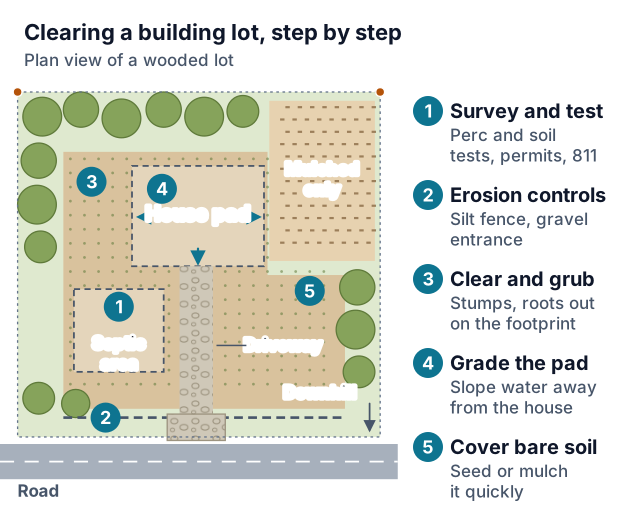
Cleared ground erodes until something covers it. EPA's construction fact sheets describe the standard tools: silt fence, a temporary sediment barrier of porous fabric; a stabilized construction entrance, a gravel pad over filter cloth where trucks leave the site; keeping the trees and brush you don't need to remove, plus vegetated buffers along streams and ponds; and covering bare soil fast, by seeding it (with temporary annual species if the season is wrong for permanent seeding) or mulching it with straw, hay or wood chips (EPA).
State law decides when you need a formal plan. In North Carolina, a plan must be filed at least 30 days ahead and approved before any land-disturbing activity of more than one acre (G.S. 113A-57). NC DEQ adds that erosion control is required whatever the size. Agriculture is generally exempt, and so is timber harvesting that follows the state's Forest Practice Guidelines (NC DEQ).
Nesting birds and protected species
The Migratory Bird Treaty Act prohibits taking protected migratory birds without federal authorization (USFWS). It covers their nests and eggs, and the protected list has more than 1,100 species. In its 2025 nest memorandum, USFWS says the MBTA generally does not require a permit to destroy an inactive nest, as long as no one keeps the nest or its contents. Destroying an in-use nest, one with viable eggs or nestlings, needs MBTA authorization (USFWS). Before removing an inactive nest, USFWS says to confirm it is not protected under the Endangered Species Act or the Bald and Golden Eagle Protection Act. Nests protected under those laws cannot be removed without a valid permit (USFWS).
USFWS guidance is to schedule vegetation removal outside the peak bird breeding season where practicable. If you can't, survey for active nests no more than five days before clearing (USFWS). Seasons vary by region, so ask your state wildlife agency for local dates. Endangered species are a separate issue. With some exceptions, the Endangered Species Act prohibits take, and take can include habitat modification that kills or injures listed wildlife (USFWS). USFWS's IPaC tool shows listed species and critical habitat that may be near your parcel.
Utilities: contact 811 before stump grinding
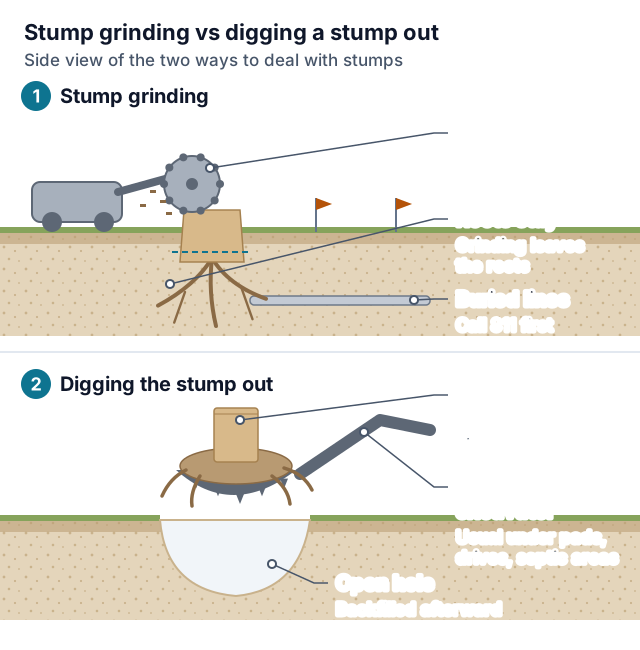
Anyone planning to dig should call 811, or use their state 811 center's website, a few business days before digging (811). The call and the line marking are free, and many states require 48 to 72 hours' notice (PHMSA). 811 does not single out stump grinding. Grinding and root raking both go below grade, though, so treat them as digging.
County permits and tree ordinances
Counties and cities may require a land-disturbance or grading permit, a tree removal permit or zoning review, often with agricultural or single-family exemptions. For example, Austin, Texas requires a permit to remove a "protected" tree, 19 inches or more in diameter at 4.5 feet above the ground, and prohibits removing larger "heritage" trees of listed species except as its code allows (City of Austin). Our county pages list the rules we have verified. Anywhere else, call the county planning or zoning office before the first tree comes down.
Pre-clearing checklist
Utilities: contact 811 or your state 811 center's website a few business days before any digging, including stump grinding. The service is free (811).
Wetlands and water: find any wetlands, streams or ponds on the property. Placing fill or dredged material in waters of the United States, including wetlands, is regulated under Clean Water Act Section 404 (EPA). If wetlands are possible, ask your county planning office or the U.S. Army Corps of Engineers district before clearing.
Local permits: ask your county or town about land-disturbance or grading permit thresholds, which vary by county; about tree ordinances and protected species; and about burn permits and seasonal burn bans before planning to burn debris. Larger sites may need an erosion and sediment control plan.
Get quotes: mark property lines and anything to keep (trees, fences, septic area). Get at least three written quotes covering method, stump removal, hauling and grading, and use the calculator as a yardstick.
Your county planning office, state agency and USACE district have the final word on your parcel.
How location changes the number
Marion County, FL: 5,420 new 1-unit buildings in 2025. Trees ≥10 in DBH protected outside single-family parcels.
Lake County, FL: 3,999 new builds. $290 permit + $50/tree (residential cap $1,450).
Johnston County, NC: 2,633 new builds. County-run erosion program; plan required >1 acre.
Union County, NC: 2,387 new builds. Steepest ground of the six (16.9% of soils ≥8% slope).
Bell County, TX: 2,170 new builds. Golden-cheeked warbler breeding county.
Parker County, TX: DFW ozone nonattainment: burn only if no practical alternative.
Frequently Asked Questions
How much does it cost to clear 1 acre of land?
$1,200–$8,000 per HomeGuide, or $500–$5,600 per Angi. A lightly wooded acre runs $500–$2,000 and a densely wooded one $3,600–$5,600 (Angi).
How much does it cost to clear 5 acres?
HomeGuide: $4,500–$35,000. Angi: $2,500–$28,000. For mulching only, HomeGuide lists $2,000–$4,000 for 5 acres.
Is it cheaper to mulch or bulldoze?
Mulching is usually cheaper per acre ($400–$800 vs $1,200–$8,000), but stumps are only ground near ground level and the roots stay. Bulldozing with stump removal is what a building site needs.
Does land clearing include stump removal?
Ask. Traditional clearing for building usually removes stumps. Mulching grinds them near ground level and leaves the roots. Separate grinding runs $120–$400 for the first stump and $30–$60 for each after (HomeGuide).
How long does it take to clear an acre?
Angi says a pro takes about 2 to 12 hours per acre depending on density. HomeGuide's forestry mulching guide says a skid-steer mulcher clears roughly 1 to 3 acres a day.
Do I need a permit to clear my own land?
Often, yes. Disturbing 1 acre or more usually needs stormwater permit coverage. Clearing in wetlands can need a federal Section 404 permit, burning piles usually needs a state authorization, and many counties have tree or grading permits.
What is the best time of year to clear land?
Plan around nesting birds first. The U.S. Fish and Wildlife Service recommends scheduling vegetation removal outside the peak bird breeding season where practicable, and surveying for active nests within five days of clearing if you can't. If you plan to burn, check seasonal limits such as Virginia's 4 PM law (February 15 to April 30).
Can I burn the debris?
It depends on the state and county: NC requires a Forest Service permit near woodland. FL requires Florida Forest Service authorization, and its rule and FDEP's summary give different setbacks, so ask the field unit. TX allows burning in most attainment counties; in nonattainment counties only when no practical alternative exists. Burn bans override all of these.
Can I deduct land clearing on taxes?
Usually not as a current expense. IRS Publication 225 treats clearing land for farming as a capital cost that becomes part of the land's cost, and land is not depreciable. Farmers may deduct the ordinary cost of periodically clearing brush from productive land. Brush eradication can also count as a soil and water conservation expense under an NRCS-approved plan, capped at 25% of gross farm income. Ask a tax professional.
What's the difference between clearing and grubbing?
Clearing removes vegetation above ground. Grubbing removes stumps, roots and debris below the surface. Full site prep for construction usually includes both.
Where do the cost figures come from?
Per-acre prices are published third-party figures: HomeGuide, Land Clearing Cost (Nov 20, 2025); Angi, How Much Does It Cost to Clear Land? (Sep 28, 2026); Angi, Forestry Mulching Cost (May 30, 2026); HomeGuide, Forestry Mulching Cost (Sep 20, 2023); HomeGuide, Stump Grinding Cost (Dec 22, 2025); Angi, Site Preparation Cost (May 30, 2026). Permit, tax and program details come from the government sources listed below.
Estimates only — independent local providers quote their own pricing. Data last reviewed 2026-10.
Sources
- HomeGuide — Land Clearing Cost (Nov 2025) (third-party estimate)
- HomeGuide — Forestry Mulching Cost (Sep 2023) (third-party estimate)
- HomeGuide — Stump Grinding Cost (Dec 2025) (third-party estimate)
- Angi — How Much Does It Cost to Clear Land? (Sep 28, 2026) (third-party estimate)
- Angi — Forestry Mulching Cost (May 30, 2026) (third-party estimate)
- Angi — Site Preparation Cost (May 30, 2026) (third-party estimate)
- U.S. EPA — Stormwater Discharges from Construction Activities (updated Aug 10, 2026)
- U.S. EPA — NPDES Stormwater Program (updated May 4, 2026)
- U.S. EPA — NPDES Permits around the Nation (updated Sep 4, 2026)
- U.S. EPA — 2022 CGP Appendix B: Permit Areas Eligible for Coverage (as modified, 2025)
- U.S. EPA — Getting Coverage under EPA's Construction General Permit (updated Jul 29, 2026)
- U.S. EPA — 2022 Construction General Permit (CGP) (updated Aug 3, 2026)
- U.S. EPA — National Menu of BMPs for Stormwater: Construction (updated Dec 12, 2025)
- U.S. EPA — BMP fact sheet: Silt Fences (2021)
- U.S. EPA — BMP fact sheet: Construction Track-Out Controls (2021)
- U.S. EPA — BMP fact sheet: Preserving Natural or Existing Vegetation (2021)
- U.S. EPA — BMP fact sheet: Vegetated Buffers (2021)
- U.S. EPA — BMP fact sheet: Seeding (2021)
- U.S. EPA — BMP fact sheet: Mulching (2021)
- U.S. EPA — Permit Program under CWA Section 404 (updated Feb 17, 2026)
- U.S. EPA — Exemptions to Permit Requirements under CWA Section 404 (updated Mar 10, 2026)
- eCFR — 33 CFR 323.2, Definitions (discharge of dredged material) (current Oct 14, 2026)
- U.S. EPA — About Waters of the United States (updated Sep 9, 2026)
- U.S. EPA — Waters of the United States (updated Oct 14, 2026)
- U.S. Army Corps of Engineers — Regulatory Boundaries (district locator)
- Florida Forest Service (FDACS) — Burn Authorizations
- Florida Administrative Code — Rule 5I-2.006, Open Burning Allowed (eff. Oct 19, 2014)
- Florida DEP — Open Burning (modified Apr 1, 2024)
- N.C. Forest Service — Open Burning Permits in North Carolina (modified Sep 23, 2026)
- NC DEQ Division of Air Quality — Open Burning
- NC DEQ — Burning Questions
- NC Administrative Code — 15A NCAC 02D .1903, Open burning without an air quality permit (amended Sep 1, 2023)
- TCEQ — Outdoor Burning in Texas (RG-049, rev. Oct 2025)
- Georgia Forestry Commission — Burn Permits and Notifications
- Georgia EPD — Annual Ban on Open Burning (Apr 29, 2026)
- Virginia Department of Forestry — 4 PM Burning Law
- North Carolina General Assembly — G.S. 113A-57, Mandatory standards for land-disturbing activity
- NC DEQ — Erosion and Sediment FAQs
- U.S. Fish and Wildlife Service — Migratory Bird Treaty Act of 1918
- USFWS — Migratory Bird Permit Memorandum MBPM-2 (nests) (Jan 15, 2025)
- USFWS — Nationwide Avoidance and Minimization Measures for Birds (version 2, Jul 2024)
- USFWS — Permits for Native Endangered and Threatened Species
- USFWS — IPaC: Information for Planning and Consultation
- 811 — Before You Dig
- U.S. DOT PHMSA — Call Before You Dig
- City of Austin, Texas — City Arborist: protected and heritage trees
- USDA NRCS — Environmental Quality Incentives Program (EQIP)
- USDA NRCS — Payment Schedules
- USDA NRCS — Florida Payment Schedules
- USDA NRCS — Texas Payment Schedule
- IRS — Publication 225 (2025), Farmer's Tax Guide
- IRS — Publication 946 (2025), How To Depreciate Property
Prefer to just talk to someone?
Send the short form — we'll route you to an independent local pro.