Forestry Mulching vs. Bulldozing: Cost, Soil and Which to Choose
Which clearing method fits your project, and how each affects cost and the soil. A forestry mulcher grinds trees and brush where they stand and leaves the roots. A bulldozer pushes trees over, roots and all, and piles them for hauling, burning or grinding.
Mulching suits trails, fence lines, hunting land, views and pasture you won't till. A dozer suits a building pad, a driveway or a pasture you will till, because the roots come out. Many jobs use both: mulch the bulk of the acreage and doze only the build site.
At a glance
| Forestry mulching | Bulldozing | |
|---|---|---|
| How it works | A mulching head grinds trees and brush in place and leaves a layer of chips | A dozer pushes trees over, roots and all, and piles them |
| Published cost | $1,000–$2,500 per acre or $150–$300 an hour (Angi, May 2026); $400–$800 per acre and $125–$300 an hour (HomeGuide, 2023) | Traditional clearing: $1,200–$8,000 per acre by density (HomeGuide) |
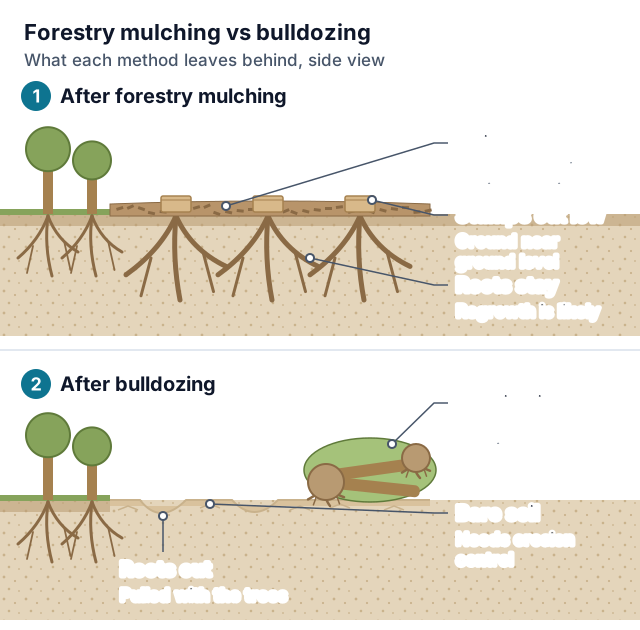
| Stumps and roots | Stumps ground near ground level; roots stay | Roots come out with the trees |
| Debris | Nothing to haul and no piles to burn | Piles to haul, burn or grind; burning brings state permit rules |
| Soil | Chip layer protects against erosion (USDA Forest Service review) | Shearing may increase compaction and reduce soil organic matter (Mississippi State Extension); bare ground needs erosion control |
| Best fit | Trails, fence lines, hunting land, selective clearing, views, pasture reclamation | House pads, septic areas, driveways, pasture you will till |
Forestry mulching
A mulching head grinds trees and brush in place and leaves a layer of chips on the ground. Angi puts mulching at $1,000 to $2,500 per acre, or $150 to $300 an hour (updated May 2026). HomeGuide's older 2023 guide says $400 to $800 per acre and $125 to $300 an hour. There is nothing to haul and no piles to burn. It suits trails, fence lines, hunting land and selective clearing. Stumps are ground near ground level, but the roots stay.
The chip layer matters for erosion. A 2018 USDA Forest Service review of mastication research summarizes studies finding slight to insignificant erosion as long as a layer of masticated chips stayed on site, and one finding that residue covering more than 25% of the ground reduced erosion. Most of those studies were in western forest types, so treat them as a direction, not a guarantee for your soil.
Bulldozing
A dozer pushes trees over, roots and all, and piles them. It is the better fit when you need a building pad, a pasture you will till or a driveway, because the roots come out. You then pay to haul, burn or grind the piles, and burning brings state permit rules (see the permits section of our land clearing cost guide).
The trade-off is soil disturbance. Mississippi State University Extension notes research showing that shearing with bulldozers may increase soil compaction and decrease soil organic matter, and that the loss is worse when the sheared material is pushed into windrows. Bare ground left behind needs erosion control. In a wetland, mechanized clearing that moves soil can need a federal permit.
How to choose
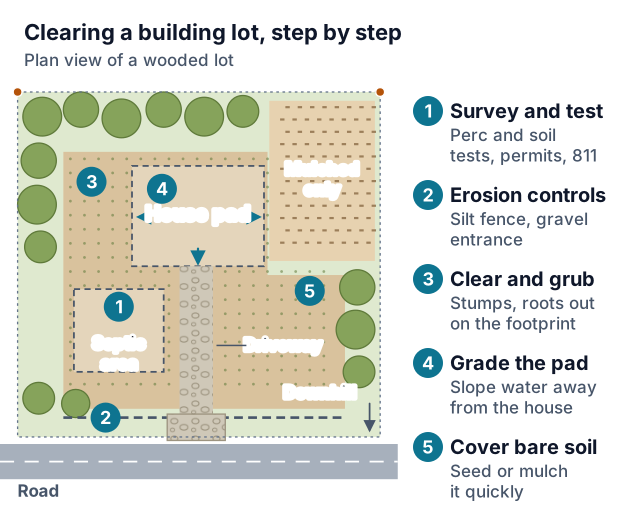
Building a house or a septic system? You will want the roots out on the footprint, which points to a dozer, at least there. Reclaiming pasture, opening views or cutting trails? Mulching avoids debris disposal and leaves a protective chip layer.
Expect regrowth after mulching, though. Mississippi State Extension cautions that for forestry site preparation, mulching rarely gives long-lasting control of the vegetation it removes. It also calls mulching too costly ($200 to $500 per acre in its figures) for most forestry site preparation.
Many jobs mix the two: mulch the bulk of the acreage and doze only the build site. Ask each bidder to price clearing, stumps, debris and grading separately so you can compare the methods line by line.
Frequently Asked Questions
Is it cheaper to mulch or bulldoze?
Mulching is usually cheaper per acre: $400–$800 (HomeGuide, 2023) or $1,000–$2,500 (Angi, May 2026), against $1,200–$8,000 for traditional clearing (HomeGuide). But it leaves the roots, so a building site still needs a dozer or excavator on the footprint.
Do I need to remove stumps?
For lawns, pastures you will mow, or building sites, yes. For trails and wooded lots, ground-level mulching is usually enough.
Does forestry mulching stop regrowth?
Not for long. Mississippi State University Extension cautions that mulching rarely gives long-lasting control of the vegetation it removes, because the roots stay in the ground.
Information only — not legal or financial advice. Data last reviewed 2026-10-28.
Sources
- Angi — Forestry Mulching Cost (May 30, 2026) (third-party estimate)
- HomeGuide — Forestry Mulching Cost (Sep 20, 2023) (third-party estimate)
- HomeGuide — Land Clearing Cost (Nov 20, 2025) (third-party estimate)
- USDA Forest Service — To Masticate or Not: Useful Tips for Treating Forest, Woodland, and Shrubland Vegetation (RMRS-GTR-381, Sep 2018)
- Mississippi State University Extension — Mechanical Site Preparation for Forestry in Mississippi (Publication 3006)
Need help figuring out next steps?
Send the short form — we'll route you to an independent local pro.